
 Español
 English
 Français
 Deutsch
 Português



- Autore:
- Pereira JM
- Matos AC.
Plasma rich in growth factors (PRGF) technology as adjuvant to Ab Externo trabeculectomy
Int Ophthalmol. 2024 Jul 22;44(1):332. Plasma rich in growth factors (PRGF) technology creates blood-derived products with growth factors that promote wound healing and regeneration. The goal of this study was to assess the potential role of PRGF products as wound modulators in trabeculectomy. Our premise is that due to PRGF's regenerative and antifibrotic properties, its use in trabeculectomy may produce a more physiological bleb, without altering IOP reduction.
- Autore:
- Eduardo Anitua
- Pino A
- Alkhraisat MH
Efficacy of Plasma Rich in Growth Factors for Healing Chronic Skin Ulcers: A Systematic Review of Randomized Controlled Trials With Meta-Analysis
Wounds. 2024 Jun;36(6):189-200. Chronic skin ulceration is a serious pathological condition for which the adjuvant use of platelet-rich plasma (PRP) has been indicated. However, evidence for the use of PRP in patients with chronic skin ulcers remains insufficient due to a large heterogeneity in experimental designs, PRP composition, and preparation protocols.
- Autore:
- Eduardo Anitua
- Tierno R
- Azkargorta M
- Elortza F
- Alkhraisat MH.
Effect of Health Status and Heat-Induced Inactivation on the Proteomic Profile of Plasma Rich in Growth Factors Obtained from Donors with Chronic Inflammatory Skin Conditions
Biomolecules. 2024 Jun 26;14(7):763. Atopic dermatitis, psoriasis and lichen sclerosus are among the most challenging conditions treated by dermatologists worldwide, with potentially significant physical, social and psychological impacts. Emerging evidence suggests that autologous-platelet-rich plasma could be used to manage skin inflammation. However, the presence of soluble autoimmune components could hinder their therapeutic potential. The aim of this study was to analyze the proteomic profile of plasma rich in growth factors (PRGFs) obtained from donors with inflammatory skin conditions to evaluate the impact of skin health status on the composition and bioactivity of PRGF-based treatments.
- Autore:
- Eduardo Anitua
- Asier Eguia
- Alkhraisat MH
Clinical Performance of Implant-Supported Prostheses in the Rehabilitation of Patients Previously Treated for Medication-Related Osteonecrosis of the Jaws (MRONJ): A Systematic Review
Cureus. 2024 Jun 4;16(6):e61658 There is a lack of consensus on managing resultant bone and soft tissue defects or on restoring oral function and aesthetics following medication-related osteonecrosis of the jaws (MRONJ) lesion healing. This clinical challenge presents a dilemma for practitioners. Removable prostheses pose a recurrence risk if poorly fitted and may inadequately restore function or aesthetics in cases of significant bone defect. Dental implant-supported prostheses could enhance function and quality of life, though their risks and indications are not well-defined. This systematic review examines the clinical outcomes and complications associated with implant-supported rehabilitations post-MRONJ surgery. This study was conducted following the Preferred Reporting Items for Systematic Reviews and Meta-Analyses (PRISMA) statement recommendations and it was pre-registered in the Prospective Register of Systematic Reviews (PROSPERO) (CRD42023492539).
- Autore:
- Fernández-Vega-Cueto L
- Alfonso-Bartolozzi B
- Alvarado-Villacorta R.
Early epithelial recovery with blood-based therapy in Meesmann dystrophy: Confocal microscopy and clinical correlation
J Fr Ophtalmol. 2024 Jun;47(6):104184.
- Autore:
- Cantero MM
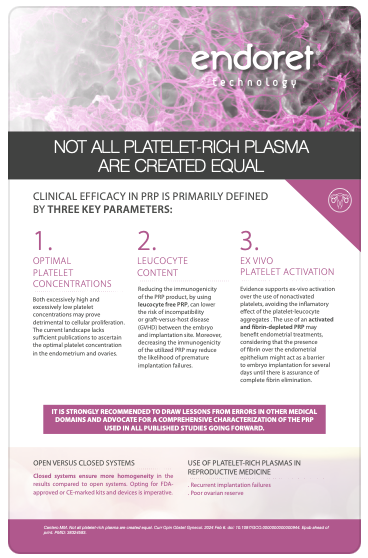
Not all platelet-rich plasma are created equal
Curr Opin Obstet Gynecol. 2024 Jun 1;36(3):118-123. This review aims to elucidate potential variations in clinical outcomes resulting from the use of different types of platelet-rich plasma (PRPs) in reproductive medicine. It seeks to explore the reasons behind the diverse results reported in various studies and assess the general features distinguishing different PRP formulations.
- Autore:
- Eduardo Anitua
- Zalduendo M
- Tierno R
- Alkhraisat MH
Plasma Rich in Growth Factors in Bone Regeneration: The Proximity to the Clot as a Differential Factor in Osteoblast Cell Behaviour
Dent J (Basel). 2024 Apr 24;12(5):122. The osteogenic differentiation process, by which bone marrow mesenchymal stem cells and osteoprogenitors transform into osteoblasts, is regulated by several growth factors, cytokines, and hormones. Plasma Rich in Growth Factors (PRGF) is a blood-derived preparation consisting of a plethora of bioactive molecules, also susceptible to containing epigenetic factors such as ncRNAs and EVs, that stimulates tissue regeneration. The aim of this study was to investigate the effect of the PRGF clot formulation on osteogenic differentiation. Firstly, osteoblast cells were isolated and characterised. The proliferation of bone cells cultured onto PRGF clots or treated with PRGF supernatant was determined.
- Autore:
- Eduardo Anitua
- Troya M
- Zalduendo M
- Tierno R
- Alkhraisat MH
- Osinalde N
- Fullaondo A
- Zubiaga AM
Improving the mechanical and biological functions of cell sheet constructs: The interplay of human-derived periodontal ligament stem cells, endothelial cells and plasma rich in growth factors
Biomed Pharmacother. 2024 May:174:116599. The aim of this study was to produce and characterize triple-layered cell sheet constructs with varying cell compositions combined or not with the fibrin membrane scaffold obtained by the technology of Plasma Rich in Growth Factors (mPRGF).
- Autore:
- Eduardo Anitua
- Lozano-Sanroma J
- Barros A
- Alcalde I
- Alvarado-Villacorta R
- Sánchez-Ávila RM
- Queiruga-Piñeiro J
- Cueto LF
- Merayo-Lloves J
Efficacy and Safety of Plasma Rich in Growth Factor in Patients with Congenital Aniridia and Dry Eye Disease
Diseases. 2024 Apr 11;12(4):76. Congenital aniridia is a rare bilateral ocular malformation characterized by the partial or complete absence of the iris and is frequently associated with various anomalies, including keratopathy, cataract, glaucoma, and foveal and optic nerve hypoplasia. Additionally, nearly 50% of individuals with congenital aniridia experience symptoms of ocular dryness. Traditional treatment encompasses artificial tears and autologous serum. This study aimed to assess the effectiveness and safety of using platelet rich in growth factors (PRGF) plasma in patients with congenital aniridia and ocular dryness symptoms.
- Autore:
- Eduardo Anitua
- Ricardo Tejero
- Romero Gavilán F
- Cerqueira A
- Muñoz F
- García Arnáez I
- Azkargorta M
- Elortza F
- Gurruchaga M
- Goñi I
- Suay J
Enhancing the correlation between in vitro and in vivo experiments in dental implant osseointegration: investigating the role of Ca ions
J Mater Chem B. 2024 Mar 13;12(11):2831-2842 This study delves into the osteogenic potential of a calcium-ion modified titanium implant surface, unicCa, employing state-of-the-art proteomics techniques both in vitro (utilizing osteoblasts and macrophage cell cultures) and in vivo (in a rabbit condyle model).