
 Español
 English
 Français
 Deutsch
 Italiano



- Autor:
- Eduardo Anitua
- Ríos Luna A
- Fahandezh-Saddi Díaz H
- Villanueva Martínez M
- Iglesias R
- Prado R
- Padilla S
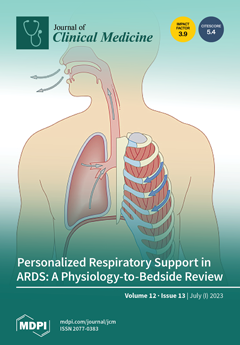
Office-Based Intraosseous Infiltrations of PRGF as an Effective Treatment for Knee Osteoarthritis: A Retrospective Observational Clinical Study
J Clin Med. 2023 Jul 6;12(13):4512. The aim of this study was to explore and assess office-based ultrasound-guided intraosseous and intra-articular infiltrations of plasma rich in growth factors (PRGF) in patients with moderate and severe knee osteoarthritis (KOA). Seventy-nine patients (30 women and 49 men) with grade 3-4 KOA according to the Kellgren-Lawrence classification participated in the study. All patients were treated with a minimally invasive technique using local anesthesia WALANT (wide-awake local anesthesia no tourniquet) in the ambulatory setting. A PRGF intra-articular infiltration and two intraosseous infiltrations in the tibial plateau and femoral condyle were performed weekly for a total of three sessions. The evaluation of the results was carried out using knee injury and osteoarthritis outcome score (KOOS) at baseline and post-treatment.
- Autor:
- Eduardo Anitua
- Ander Pino
- García A
- Navarro MR
- Ramirez A
- Navarro A
- Moles I
- Gallego E
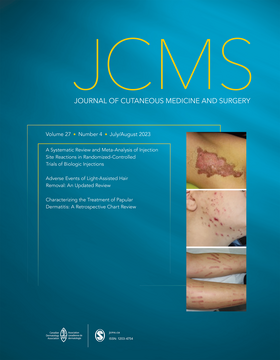
Plasma Rich in Growth Factors as an Adjuvant Treatment for the Management of Frontal Fibrosing Alopecia: A Retrospective Observational Clinical Study
J Cutan Med Surg. 2023 Jul-Aug;27(4):340-349. Frontal fibrosing alopecia (FFA) is a scarring alopecia in which the exact etiopathogenesis has not been completely elucidated and the available treatments are not very effective. Plasma rich in growth factors (PRGF) has shown to induce folliculogenesis in hair loss related disorders. However, the scientific evidence when facing FFA is scarce.
- Autor:
- Ghalibafan S
- Osei K
- Amescua G
- Sabater A.
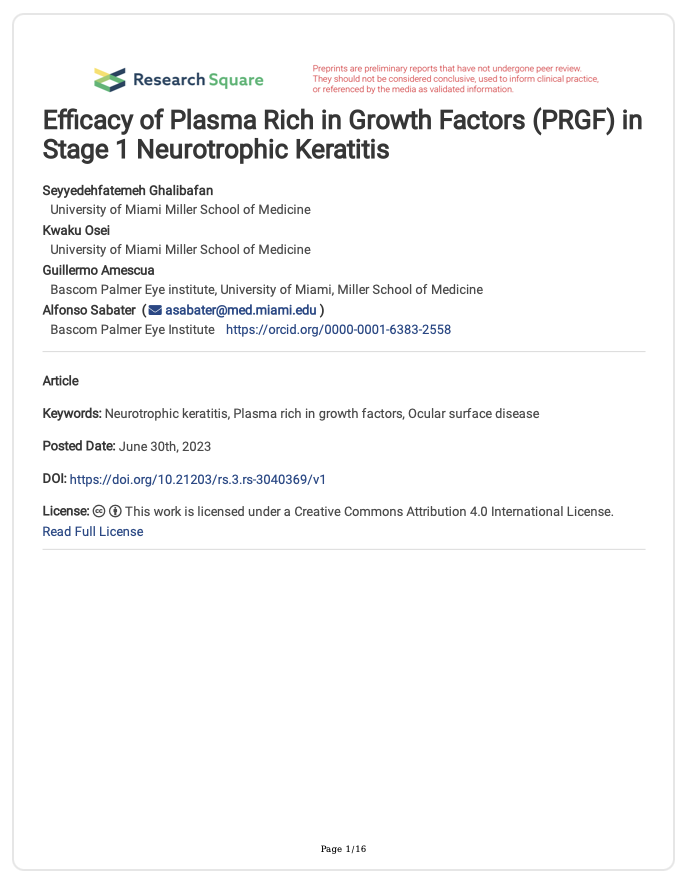
Efficacy of Plasma Rich in Growth Factors (PRGF) in Stage 1 Neurotrophic Keratitis
Res Sq [Preprint]. 2023 Jun 30:rs.3.rs-3040369. Neurotrophic keratitis (NK) is a neurodegenerative disease that can lead to corneal hypoesthesia, decreased tear production, and epitheliopathy. Based on the severity of ocular surface damage, NK is classified into 3 stages. Stage 1 NK is characterized by superficial punctate keratopathy, tear film instability, and reduced corneal sensation. The therapeutic efficacy of PRGF eye drops for NK stages 2 and 3 has been previously reported. In this study, we evaluated the efficacy and safety of autologous PRGF eye drops in improving corneal sensitivity and other ocular surface clinical signs in patients with stage 1 NK.
- Autor:
- Eduardo Anitua
- Muruzabal F
- de la Fuente M
- Merayo-Lloves J
- Alkhraisat MH.
Development of a new plasma rich in growth factors membrane with improved optical properties
Ann Anat. 2023 Jun;248:152071. The aim of the present work was to develop a fibrin membrane using plasma rich in growth factors (PRGF) technology with improved optical properties to be used for the treatment of ocular surface diseases.
- Autor:
- Eduardo Anitua
- Rodríguez-Calvo PP
- Rodríguez-Uña I
- Fernández-Vega-Cueto A
- Sánchez-Ávila RM
- Merayo-Lloves J.
Plasma Rich in Growth Factors as an Adjuvant Agent in Non-Penetrating Deep Sclerectomy
J Clin Med. 2023 May 22;12(10):3604. The purpose of this study is to evaluate the utility and safety of plasma rich in growth factors immunosafe eye drops (is-ePRGF) in the postoperative treatment of non-penetrating deep sclerectomy (NPDS).
- Autor:
- Eduardo Anitua
- Flores C
- Fernández-de-Retana S
- Anitua B
- Alkhraisat MH.
Performance of Immediately Loaded Short Implants Using Low-Speed Drilling Protocol and Plasma Rich in Growth Factors: A Controlled Retrospective Observational Study
Int J Periodontics Restorative Dent. 2023 May;43(2):232-239b. Short dental implants are an alternative to surgical bone augmentation procedures and the placement of longer implants. The high predictability of short implants has encouraged clinicians to load them immediately. However, there are few studies assessing the influence of immediate vs delayed loading of short (< 8 mm) implants. The purpose of this retrospective study was to report the mid-term (5-year) outcomes (survival and marginal bone loss [MBL]) of immediate vs delayed loading of short implants. A total of 44 patients with 149 short implants fulfilled the inclusion criteria (95 and 54 implants with delayed and immediate loading, respectively).
- Autor:
- Eduardo Anitua
- de la Fuente M
- Sánchez-Ávila RM
- de la Sen-Corcuera B
- Merayo-Lloves J
- Muruzábal F.
Beneficial Effects of Plasma Rich in Growth Factors (PRGF) Versus Autologous Serum and Topical Insulin in Ocular Surface Cells
Curr Eye Res. 2023 May;48(5):456-464. In the last few decades, several blood derived products such as platelet-rich plasma (PRP), plasma rich in growth factors (PRGF) and autologous serum (AS) have been used for the treatment of ocular surface disorders. Recently, insulin has been proposed to be used as an alternative for the treatment of ocular surface diseases. The aim of this study was to evaluate the biological potential of PRGF eye drops in comparison with AS and insulin on ocular surface cells.
- Autor:
- Eduardo Anitua
Two-Step Progressive Transcrestal Sinus Augmentation Using a 4.5 mm Unloaded Implant as a “Temporary Implant” in Highly Atrophic Ridge: Case Report
Eur J Dent. 2023 May;17(2):560-566. Severe atrophic posterior maxillary ridge (residual bone height < 3 mm) could be a challenging situation to place dental implants. Several treatment options have been proposed, but some of them may require advanced surgical skills to achieve best results. In this article, we present a novel and easier technique to allow implant placing in localized areas of severe atrophy. In a first step, a 4.5-length extra-short (unloaded) implant is placed after a transcrestal maxillary sinus floor augmentation (MSFA). After the gained apical bone consolidation, this "temporary implant" is atraumatically removed and a longer and wider definitive implant is placed to support the definitive single restoration. The case of a 45-year-old female treated with this approach is also presented. The patient suffered a severe resorption in the upper right molar area after a tooth extraction.
- Autor:
- Sharma A
- Wu L
- Bloom S
- Stanga P
- Figueroa M
- Govetto A
- Mirajkar A
- Nagpal M
- N Mehrotra
- A Sharma
- A Rezaei
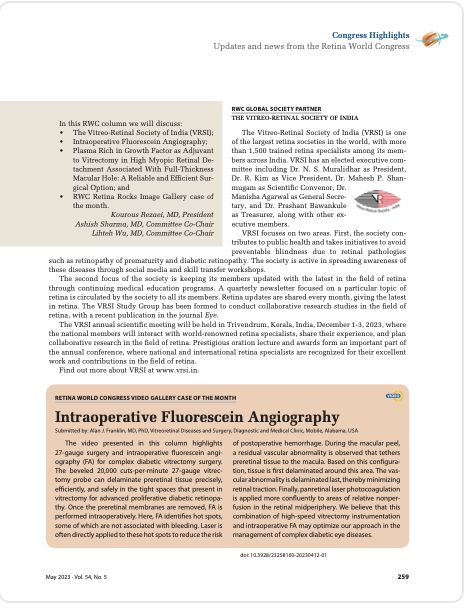
RWC Update: Intraoperative Fluorescein Angiography, Plasma Rich in Growth Factor as Adjuvant to Vitrectomy in High Myopic Retinal Detachment Associated with Full-Thickness Macular Hole, Giant Tear of the Retinal Pigment Epithelium
Ophthalmic Surgery, Lasers and Imaging Retina Volume 54, Number 5 Pages 259 - 264
- Autor:
- Eduardo Anitua
- Vaquerizo V
- García-López M
- Mena-Rosón A
- Prado R
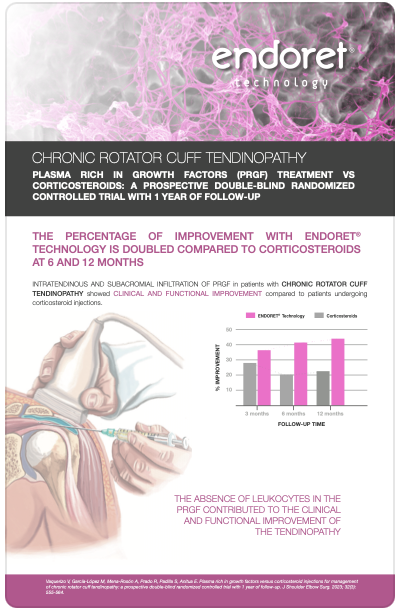
Plasma rich in growth factors versus corticosteroid injections for management of chronic rotator cuff tendinopathy: a prospective double-blind randomized controlled trial with 1 year of follow-up
J Shoulder Elbow Surg. 2023 Mar;32(3):555-564. Rotator cuff tendinopathy (RCT) is a painful and dysfunctional shoulder condition traditionally considered as a degenerative pathology. However, evidence is pointing to immunocompetent cells and activated stromal fibroblasts as the drivers of a nonresolved inflammatory condition in RCT. As potent anti-inflammatory agents, corticosteroid injections have been among the first-line and the most common therapeutic strategies. Recently, another adjuvant therapy to treat musculoskeletal inflammation-driven painful conditions, namely, platelet-rich plasma (PRP), has emerged as safe and effective.